Ibarski put 31, Nevade, 32300 G.Milanovac, Srbija

Request a Quote
SR | EN
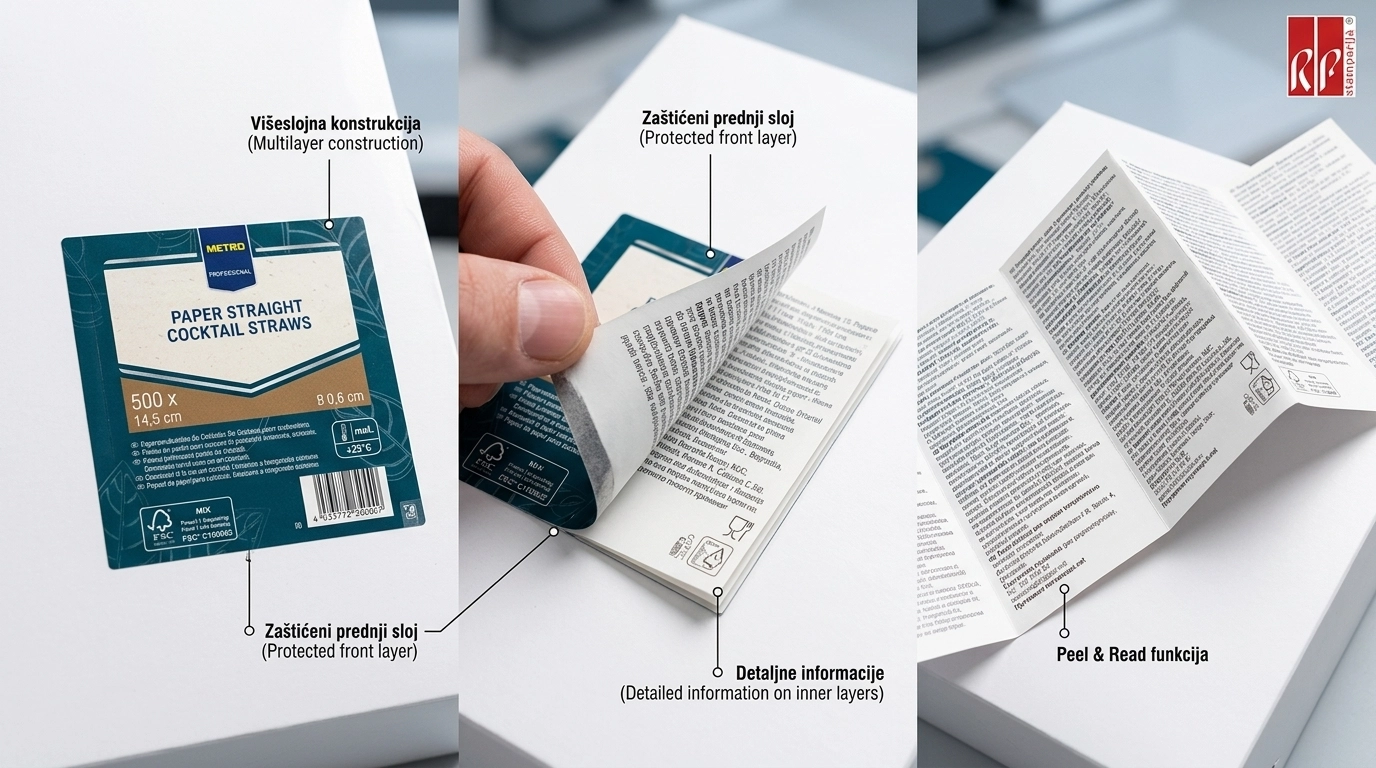
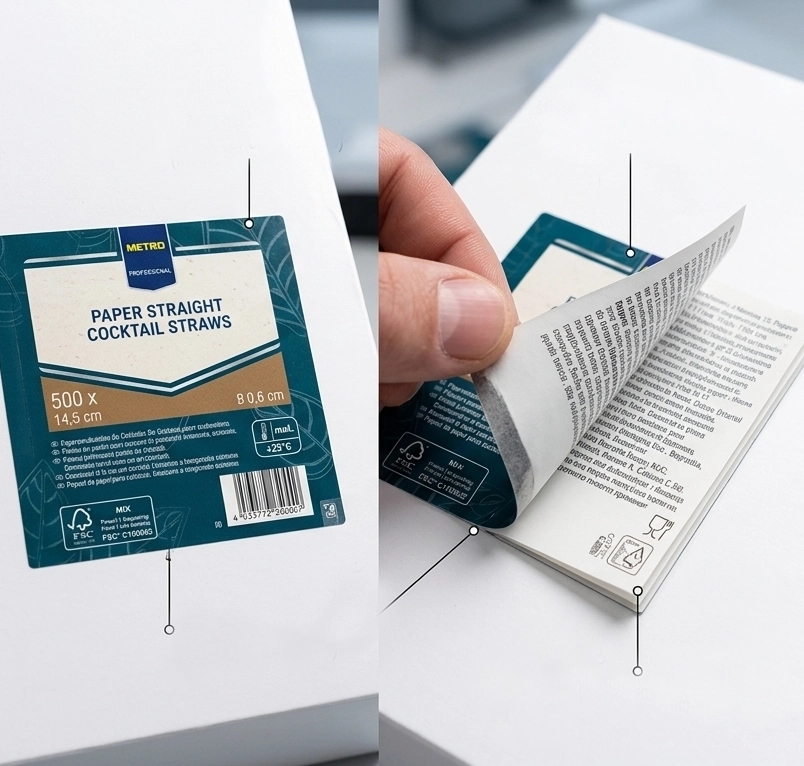
Multilayer peel-and-reveal label with the top layer lifted on a product
Peel-and-Reveal

Multilayer Labels on a Roll

A peel-and-reveal construction with two or three layers. The consumer lifts the top layer, reads the information underneath, and folds it back down. Up to 4 printed surfaces on a single label, with no increase in package size, in a thin profile that follows curved surfaces.

printed surfaces
on one label
Construction
2-3 Layers

The top layer lifts up and folds back down. A release coating gives clean separation with no residue. A pinch point prevents full removal.

Production
Delam / Relam

MPS EF 340 with a Cross-Over unit. Layer separation, printing, and rejoining in a single pass. 2 units equipped with this option.

Use Cases
Chemicals · Cosmetics · Food

EU CLP data, INCI lists, multilingual declarations, promotions. Moderate extra space in a thin profile.

Application
Standard Labelers

A thinner profile than a booklet label, applies with no modifications on any industrial labeling machine. On a roll on a core to your specification.

How It Works

The anatomy of a multilayer label, layer by layer

Four elements make up the peel-and-reveal construction: the bottom layer with the adhesive, a release coating for clean separation, the top layer with print, and a pinch point that prevents full removal.

1
Top layer (top ply)
The front of the label the consumer sees on the shelf. Printed in full color with the logo, product name, and key information. It lifts up to reveal the content underneath. The back of the top layer is also printed, giving two surfaces on a single layer.
2
Release coating (varnish)
A special coating applied to the bottom layer that lets the top layer separate smoothly, with no tearing, no adhesive residue, and no damage to the print. It is essential for repeated opening and closing, the consumer can lift the top layer and fold it back down as many times as they want.
3
Bottom layer (bottom ply) with print
The base layer bonded to the product. The front carries additional information that is revealed when the top layer is lifted: instructions, ingredients, precautions, translations. This is the third printed surface. The adhesive on the back is permanent and matched to the packaging.
4
Pinch point (stop point)
A zone on one edge where the top and bottom layers are permanently joined. It prevents full removal of the top layer, the consumer can only lift it up to that point. Without a pinch point, the top layer could come off completely and get lost. The position is defined at the prepress stage.
Production process on the MPS EF 340
01
Printing the bottom layer
The base material (PP film) passes through the printing units. The front carries the information that will be visible once the consumer lifts the top layer. A release coating is applied to the corresponding zones.
02
Delamination (Delam)
The Cross-Over unit introduces a second material (the top ply) into the production flow. The face material is separated from the liner so the back of the top layer, the third and fourth surfaces, can be printed.
03
Printing the top layer
The top ply is printed on both sides: the front (front design, logo, visual identity) and the back (additional information). Up to 9 colors per pass side.
04
Relamination (Relam)
The top and bottom layers are rejoined into a single construction. The release coating ensures the layers separate cleanly in the intended zones. The pinch point zone stays permanently bonded.
05
Die-cutting and winding
The finished multilayer label is rotary die-cut to the desired shape and wound onto a core to the customer's specification. Ready for automatic application on a labeling machine.

Multilayer or standard label, when to choose which

Both constructions carry the product's declaration, but they differ in how much text they can hold, how the front looks, and how many variants you have to keep in stock.

Characteristic Multilayer (peel-and-reveal) Standard single-layer
Content capacity Up to 4 printed surfaces (2 layers times 2 sides) One printed surface
Space for the declaration Extra space with no increase in label size More text means a larger label or smaller type
Front appearance Stays clean, required text is hidden underneath The brand shares space with required information
Multiple languages on the product 2 to 3 languages on one label for multiple markets Typically a separate label for each market
User experience Peel, read, fold back down All information visible right away
Profile on the package Thin, close to a standard label Thinnest possible
Machine application Standard labeling machines, no modification Standard labeling machines, no modification
Cost per unit Higher than standard, with savings on the number of variants Lowest per unit
When to choose it When the text does not fit or the front has to stay clean When all the information fits on one side

Not sure which type you need? Tell us about the product, the amount of text, and the number of languages. We will recommend the optimal construction based on your specific requirements. If you need a label that reseals on the package, take a look at open-close labels.

01Construction and Materials

Two PP layers, a release coating, and permanent adhesive, all in one label

A typical multilayer label consists of two polypropylene (PP) layers joined so the top one separates cleanly from the bottom. A release coating on the bottom layer allows the top layer to lift smoothly with no tearing and no adhesive residue. The adhesive on the back of the bottom layer is permanent and matched to the packaging type.

Materials are chosen for the conditions of use: PP film for standard conditions, PET for chemical resistance and durability, specialty adhesives for humid and cold environments. All materials come from certified suppliers (Raflatac, Fasson, Tores, Intercoat).
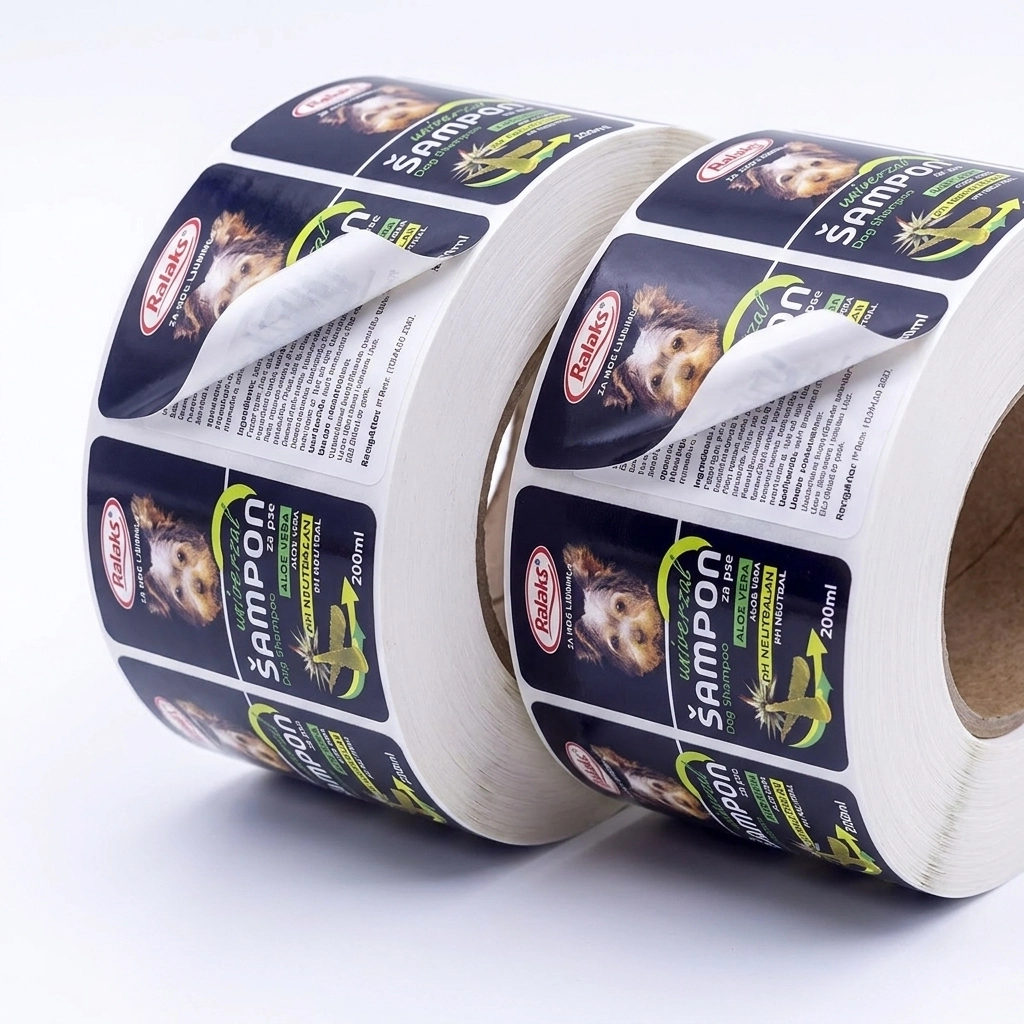
Cross-section of a multilayer label with two PP layers and a release coating
PP (polypropylene) film for both layersThe most common material for multilayer labels. Flexible, resistant to moisture, follows curved packaging surfaces with no wrinkling. Clear PP enables a no-label look where the top layer visually blends into the packaging.
Release coating for controlled separationApplied to the front of the bottom layer in zones defined at prepress. The quality of the release coating directly affects how smoothly it opens, how cleanly the layers separate, and how many opening and closing cycles the label can withstand without degrading.
Permanent adhesive matched to the packagingStandard acrylic adhesive for flat and slightly curved surfaces. Reinforced adhesive for HDPE plastic and uneven textures. Specialty adhesive for low temperatures (refrigerators, freezers) or humid environments. The adhesive type is defined based on your product.
PET option for demanding conditionsWhen the product requires resistance to chemicals, solvents, or high temperatures, PP is replaced with PET film. PET is stiffer and more durable than PP, but less flexible on curved surfaces. The choice depends on the conditions of use and the packaging type.
02Use by Industry

Moderate extra space, quick consumer interaction, a thinner profile than a booklet label

Multilayer labels are the right fit for products that need a moderate amount of extra space for information, where the consumer needs to quickly check a detail (ingredients, dosage, warning), and where a booklet label's thicker profile is not desirable. They deliver the most value for the chemical industry, cosmetics, household chemicals, and food products sold in 2 to 3 markets.
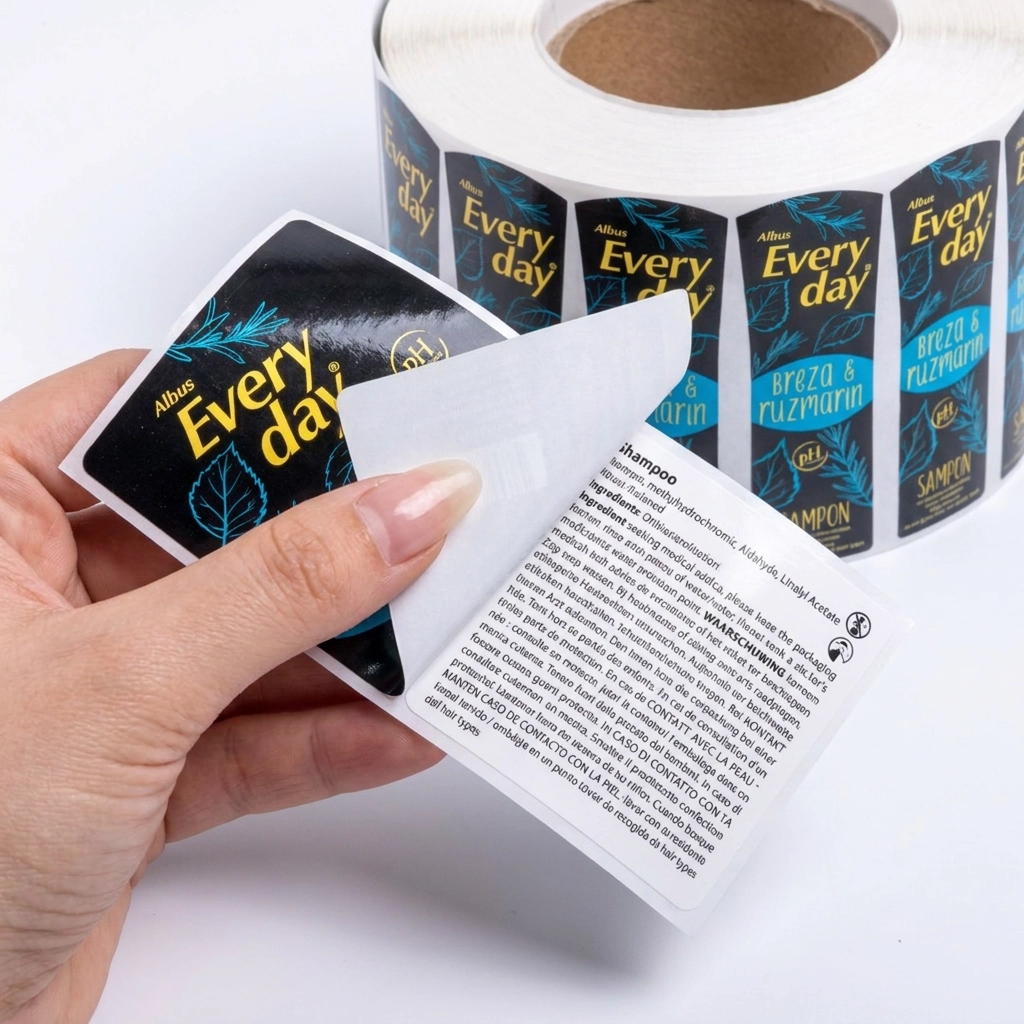
Multilayer labels on chemical and cosmetics industry products
Chemical industry and household chemicalsEU CLP regulation requires hazard pictograms, warning labels, precautionary statements, and first-aid information. On small packages of detergents, cleaning products, and industrial chemicals, a multilayer label carries all the required data with no need for larger packaging. The top layer keeps a clean, branded front.
Cosmetics and personal careThe INCI ingredient list, directions for use, warnings, and information in 2 to 3 languages on small packaging (creams, serums, lotions). The multilayer construction preserves a premium visual identity on the top surface while the regulatory information stays hidden underneath. Its thinner profile than a booklet label does not disrupt the aesthetics of premium products.
Food industryNutrition tables, allergens, preparation instructions, origin information in 2 to 3 languages. Especially useful for products exported to markets with different regulatory requirements, since one label covers every language with no need for separate packaging variants.
Promotions and marketing campaignsThe top layer carries the product's front design, and under the peel layer sits a coupon, a sweepstakes code, a recipe, or an added offer. The consumer lifts the layer, finds the promotion, and puts the label back. A way to add marketing content with no change to the base label and no extra packaging.
03Benefits for the Packaging Chain

Fewer SKU variants, simpler logistics, savings on packaging

Multilayer labels bring more than just extra space for information. They bring measurable savings across the whole packaging chain: fewer SKU variants by language, elimination of separate inserts, the option to use smaller packaging, and simpler logistics since the same product ships to multiple markets.
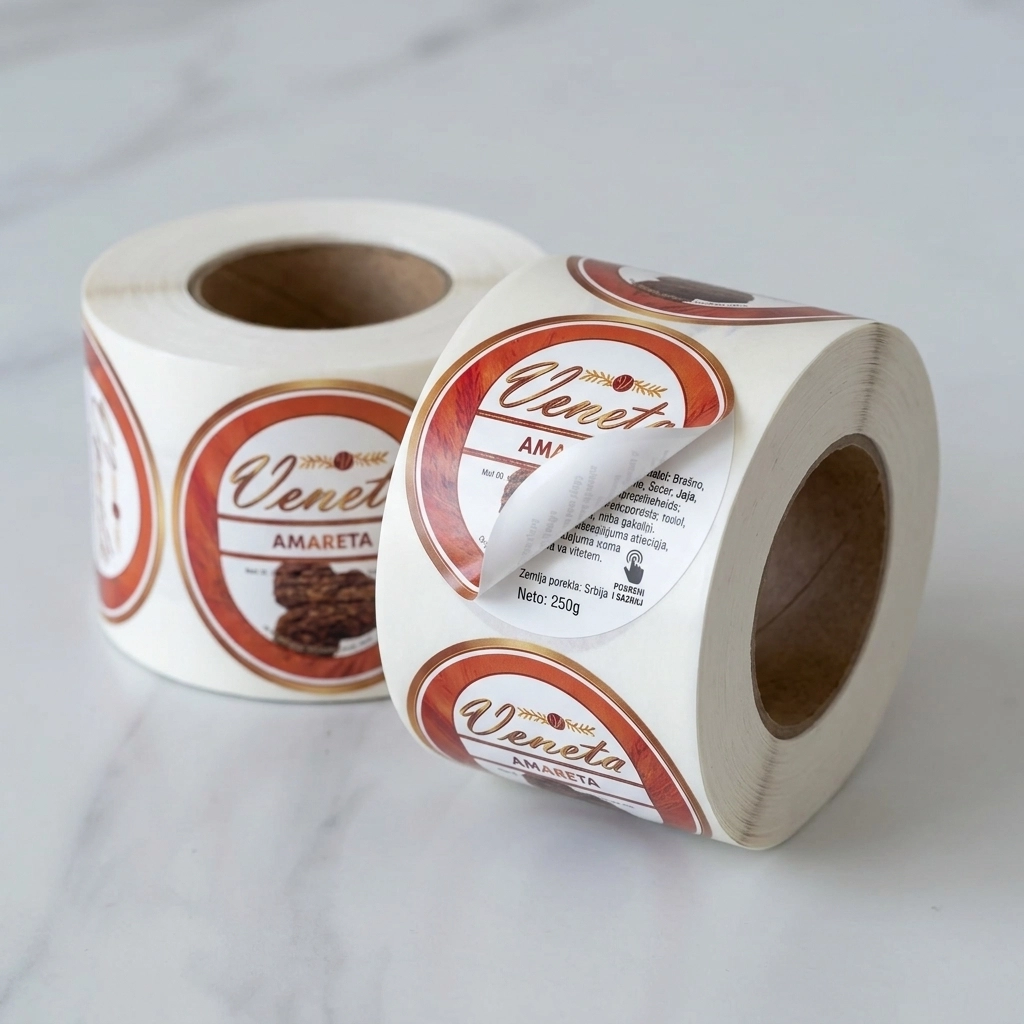
Rolls of multilayer labels ready for delivery
Fewer SKU variants by languageInstead of a separate label for each market (Serbian, English, German), one multilayer label carries every language. The same product ships to every market with no change to the packaging. Fewer SKU variants means less inventory, fewer distribution errors, and simpler warehouse management.
Elimination of separate insertsInformation that would otherwise sit on a separate paper insert inside the box is now built into the label. No extra step in packaging (inserting the leaflet), no risk of a missing insert, no cost of printing and handling a separate document.
The option to use smaller packagingWhen the information moves onto the label, the packaging no longer needs to be large enough to hold a paper insert. Some products can move to a smaller box or eliminate the box entirely. Smaller packaging means less material, lower shipping costs, and a smaller environmental footprint.
Application on standard labeling machinesUnlike booklet labels, which can require adjusting the labeling machine's settings, multilayer labels have a thinner profile and apply as standard on any industrial labeling machine with no modifications. Delivered on a roll on a core to your specification.
04Technical Requirements

What you should know before requesting a quote for multilayer labels

Multilayer labels require a precise specification because the construction is defined up front and is difficult to change once the die-cutting tool is made. The more information you provide in your inquiry, the faster we can prepare a quote and recommend the optimal construction. Here is what is useful to have ready.

Technical specification and prepress preparation for multilayer labels
Label dimensions and shapeOverall label dimensions (top layer), the dimensions of the peel zone (the part that lifts), and the pinch point position. Label shape: rectangle, oval, rounded corners. If you do not have exact dimensions, send a photo of the packaging with measurements, and we will recommend an optimal format.
Content for all 4 surfacesThe front of the top layer (front design), the back of the top layer, the front of the bottom layer, and the back of the bottom layer (which is bonded to the product and is usually not printed). Provide the text for all surfaces, or at least indicate how much text needs to fit on each.
Packaging informationWhat the label is bonded to (glass, PET, HDPE, PP, cardboard), surface curvature (flat, slightly curved, cylindrical), storage conditions (dry, humid, cold), and application method (manual, semi-automatic, automatic on a line). This data determines the material and adhesive choice.
Order volume and unwind directionApproximate annual volume and individual order size. Core (40 mm or 76 mm most commonly), maximum roll diameter, and unwind direction. If you are not sure about these parameters, send a photo of your existing roll and labeling machine, and we will work out the specification.
Pinch point positionWhere you want the top layer permanently fixed: at the top edge, bottom, left, or right. The pinch point position affects the opening direction and the consumer experience. If you have no preference, we will recommend an optimal position based on the label shape and packaging dimensions.
Frequently Asked Questions

Multilayer Labels, Before You Send an Inquiry

Answers to the questions procurement teams, technologists, and brand managers ask us most often about peel-and-reveal labels with two or three layers.

Categories
Need a Consultation?
Describe your product and packaging, and we will recommend the optimal construction.
Send an Inquiry

Up to 4 printed surfaces: the front of the top layer (the front design the consumer sees on the shelf), the back of the top layer (revealed when the layer is lifted), the front of the bottom layer (visible underneath the top layer), and the back of the bottom layer. The back of the bottom layer is bonded to the product and is usually not printed, so in practice there are most often 3 active surfaces. For many products, that is enough for all regulatory information, instructions, and 2 to 3 languages.

A quality release coating allows repeated opening and closing without degrading. In practice, the label withstands several dozen cycles of lifting and replacing the top layer. The exact number depends on the quality of the release coating, the type of material, and the conditions of use (moisture, temperature, chemical exposure). For products that require frequent checks (for example, chemical dosing), this is a key advantage because the consumer can read the information whenever needed.

No, not if the label is constructed correctly. A pinch point zone along one edge permanently joins the top and bottom layers, preventing complete removal. The consumer lifts the top layer only up to that point, reads the information underneath, and puts it back. The position of the pinch point is set during the prepress stage based on the label's shape and the intended opening direction. If for some reason you need a top layer that fully detaches (for example, a tear-off coupon), that is also possible, but it requires a different construction.

Most often from polypropylene (PP) film, which is flexible, moisture-resistant, and conforms well to curved packaging surfaces. For more demanding conditions (chemicals, solvents, high temperatures), PET film is used, which is stiffer and more durable. The adhesive is a permanent acrylic for standard surfaces, with an option for reinforced adhesive on HDPE plastic or a specialized adhesive for low temperatures. All materials come from certified suppliers: Raflatac, Fasson, Tores, and Intercoat.

Yes. PP film is flexible enough to conform to cylindrical and slightly curved surfaces without wrinkling or bubbling. For narrow cylindrical bottles (small diameter), the construction is adjusted with free zones between the peel section and the substrate to prevent material stress. Tell us the bottle diameter and surface shape in your inquiry, and we will check compatibility with the desired label dimensions.

On MPS EF 340 presses with a Cross-Over unit and Delam/Relam technology. Delamination separates the face material from the liner, printing takes place on the separated surfaces (up to 9 colors per side), and relamination rejoins the layers into a single construction. The release coating is applied in the designated zones, and the pinch point stays permanently joined. The entire process happens in a single pass. Štamparija RP has two MPS EF 340 presses equipped with this option.

Yes. The top layer carries the product's standard front design, while promotional content sits underneath the peel zone: a coupon, a sweepstakes code, a recipe, an additional offer, or usage instructions. The consumer lifts the layer, discovers the promotion, and puts the label back. This is a way to add marketing content without changing the base label, without additional packaging, and without increasing distribution costs. For seasonal promotions, only the content under the peel layer changes while the front stays the same.

It costs more than a standard self-adhesive label because it requires two layers of material, a release coating, and more complex production (the Delam/Relam process). The exact price depends on the dimensions, material, number of colors, and print run. Before comparing only the cost per piece, compare the total cost against the alternative: two separate labels, a paper insert in the box, larger packaging, or maintaining multiple SKU variants by language. In that context, a multilayer label often delivers savings across the entire packaging chain.

The minimum depends on the label dimensions, material, and number of colors. Multilayer labels are produced using the flexo process on the MPS EF 340, where the economics favor medium and larger print runs. For smaller runs, we will discuss the options openly and suggest an alternative if the economics do not work in your favor. Send us your specification (dimensions, material, number of colors, approximate quantity), and you will get a quote within 48 hours with a clear per-piece calculation.

For a first order, plan on 7 to 12 business days from proof approval, depending on the complexity of the construction and current capacity. For repeat orders with saved parameters, the lead time is shorter because the prepress setup and die-cutting tool already exist, so you do not go through those stages again. If you are working against a tight deadline, note it in your inquiry so we can check availability and arrange priority production if capacity allows.

Request a Quote

More Information,
Same Packaging

Tell us about your product, packaging, and how much extra space you need. We will recommend the construction, material, and pinch point position, along with a per-piece calculation. Quote within 48 hours.

Quote Within 48 Hours Star Proof Before Printing Application Without Modifying the Labeler
Up to 4 Printed Surfaces on a Single Label Front and back of the top layer, front of the bottom layer. Three active surfaces for regulatory information, instructions, and multilingual declarations.
Thinner Profile, Standard Application Unlike a booklet label, a multilayer label has a profile that is almost the same as a standard one. It applies on any industrial labeler without modifications.
Repeated Opening and Closing The release coating ensures smooth separation of the layers without residue. The pinch point prevents complete removal of the top layer. The consumer reads the information whenever needed.
Delam/Relam in a Single Pass on the MPS EF 340 Layer separation, printing on both sides, rejoining, and die-cutting without external operations. Two EF 340 units equipped with a Cross-Over unit.
Printed Surfaces
on One Label
MPS EF 340 Units
with Delam/Relam Option
9 Colors in a
Single Pass
48h Quote After
Inquiry Received
4 ISO and FSC
Certifications